
Fredericton Retaining Wall Builders are insured retaining wall builders in Fredericton, New Brunswick, designing and building armour stone, concrete block, poured concrete and natural stone walls for sloped yards, driveways and riverfront lots. This page explains why walls fail in the Saint John River valley, which wall type suits your site, what shapes the price, and how to book a free on-site estimate.
Retaining walls we build around Fredericton
Each service page covers one kind of wall: where it works best, how it is built to handle Fredericton frost and clay, what moves the price, and what to send us for a free estimate. Start with the material you have in mind, or with the problem you need solved, such as a sliding slope, a narrow driveway or a failing old wall.
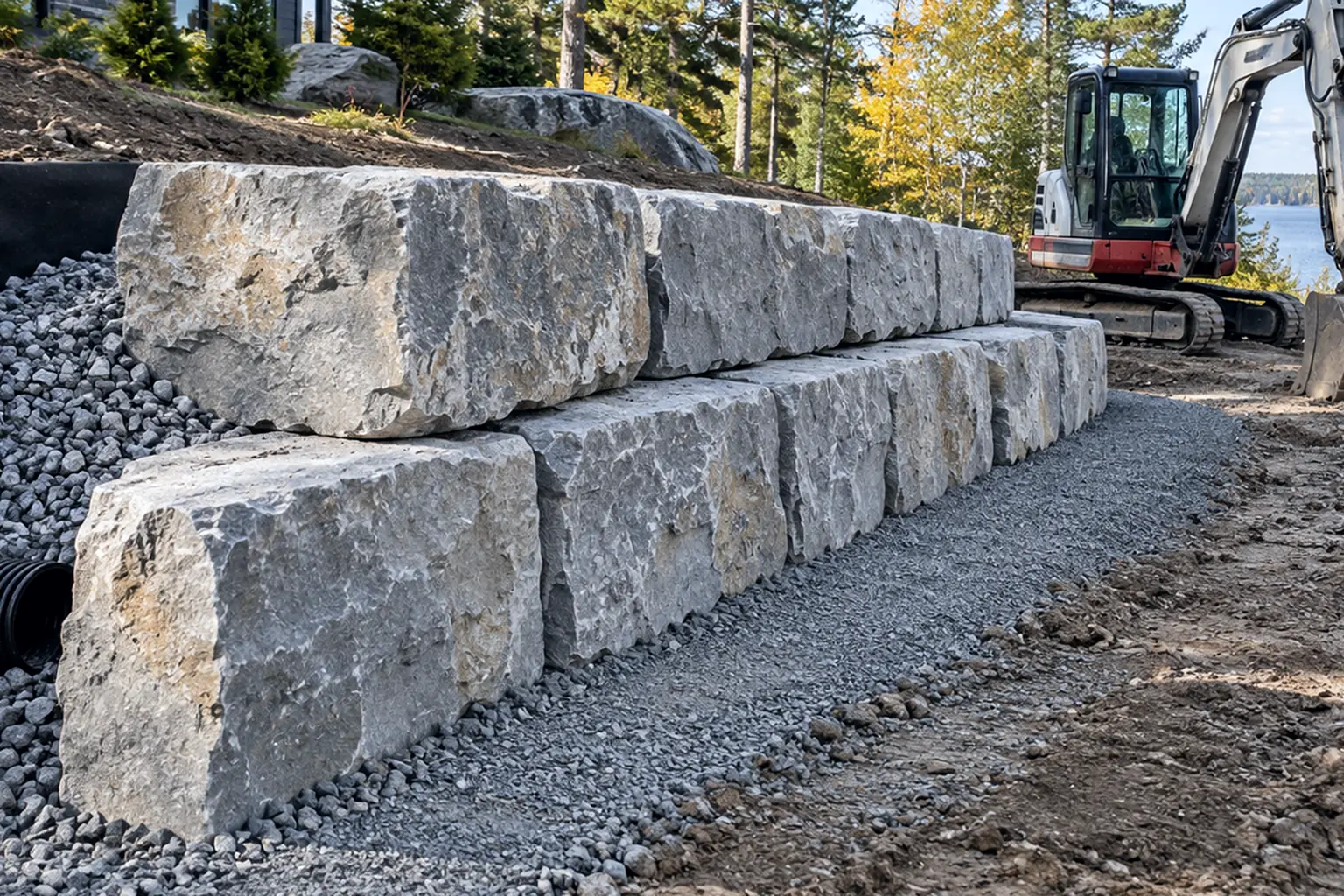
Armour Stone Retaining Walls
Massive quarried stone set by excavator for natural, long-lasting walls on slopes, large lots and waterfront.
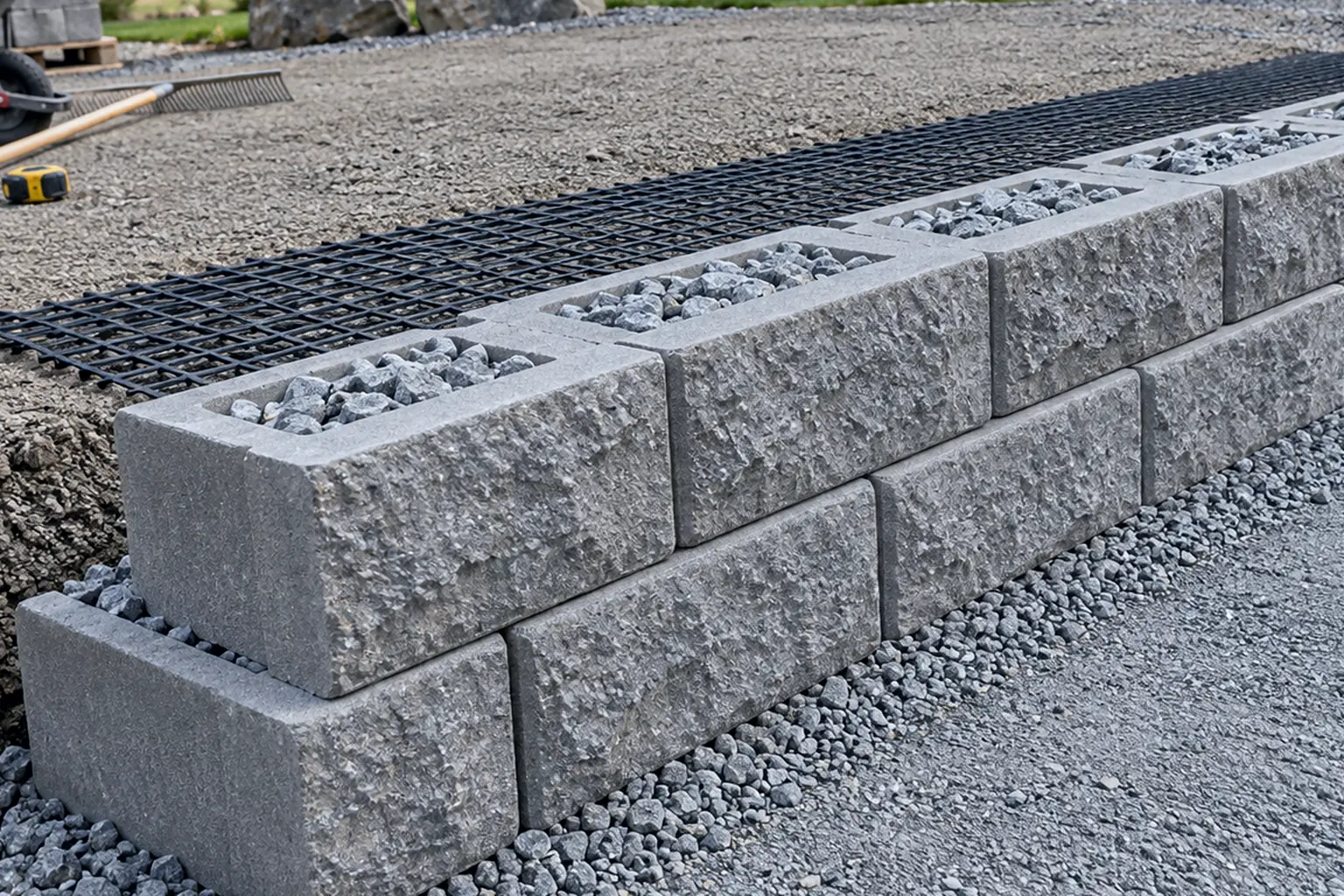
Concrete Block Retaining Walls
Interlocking segmental block walls for curves, steps and clean lines, reinforced with geogrid where height calls for it.
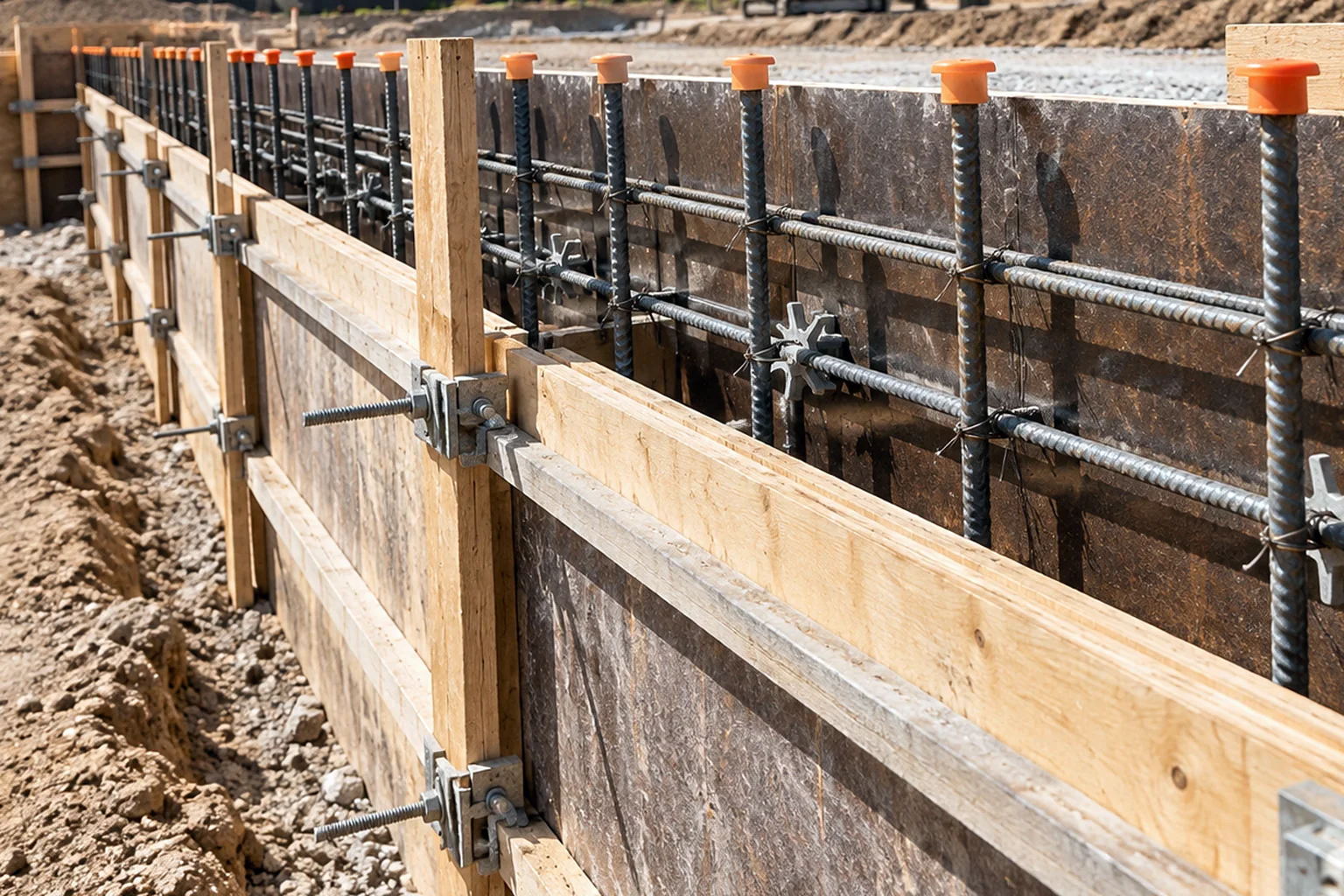
Poured Concrete Retaining Walls
Formed, steel-reinforced concrete walls for narrow sites, structural loads and clean modern lines.
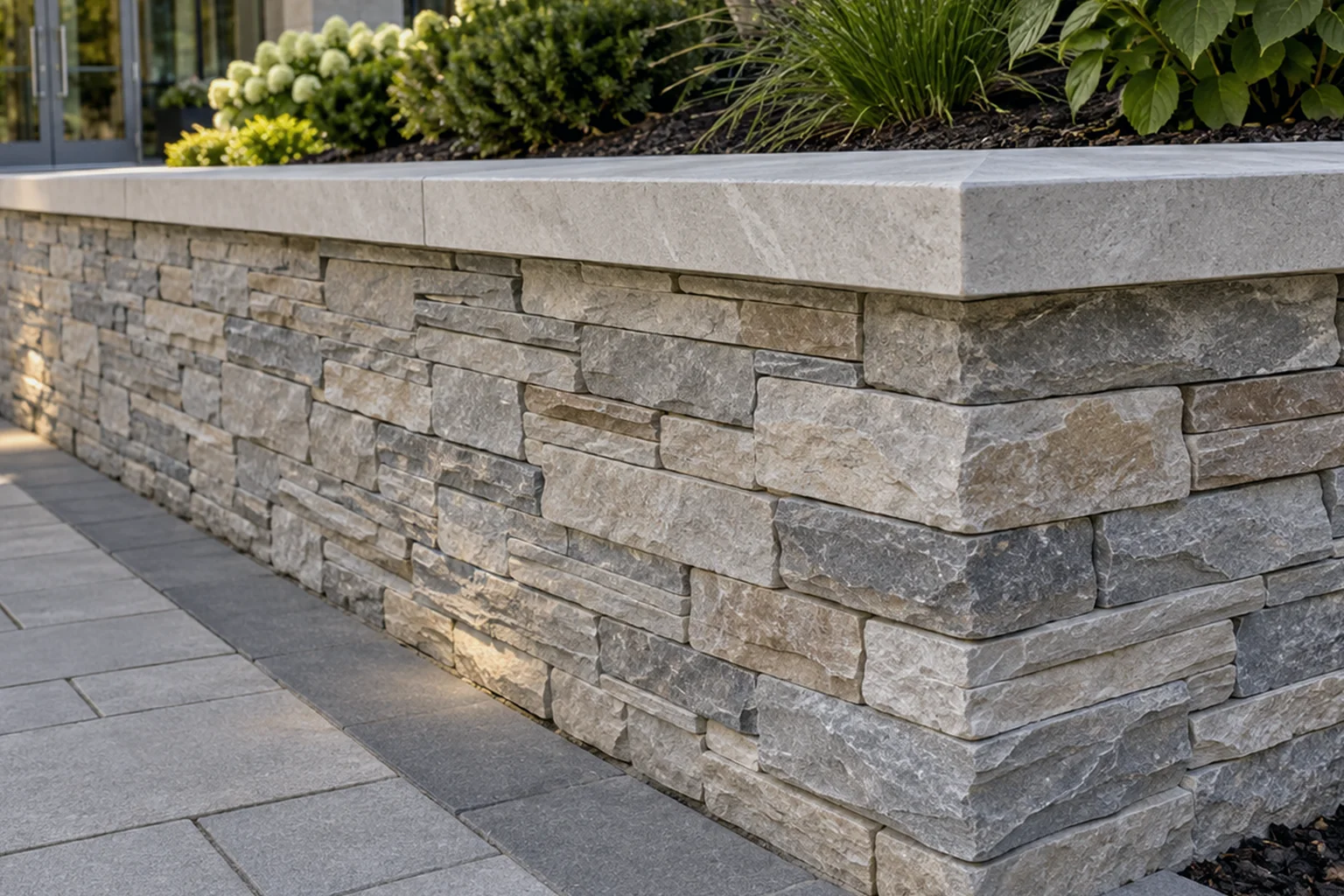
Natural Stone Retaining Walls
Dry-laid stone, flagstone and stone veneer walls for gardens, patio edges and entrances where looks matter most.
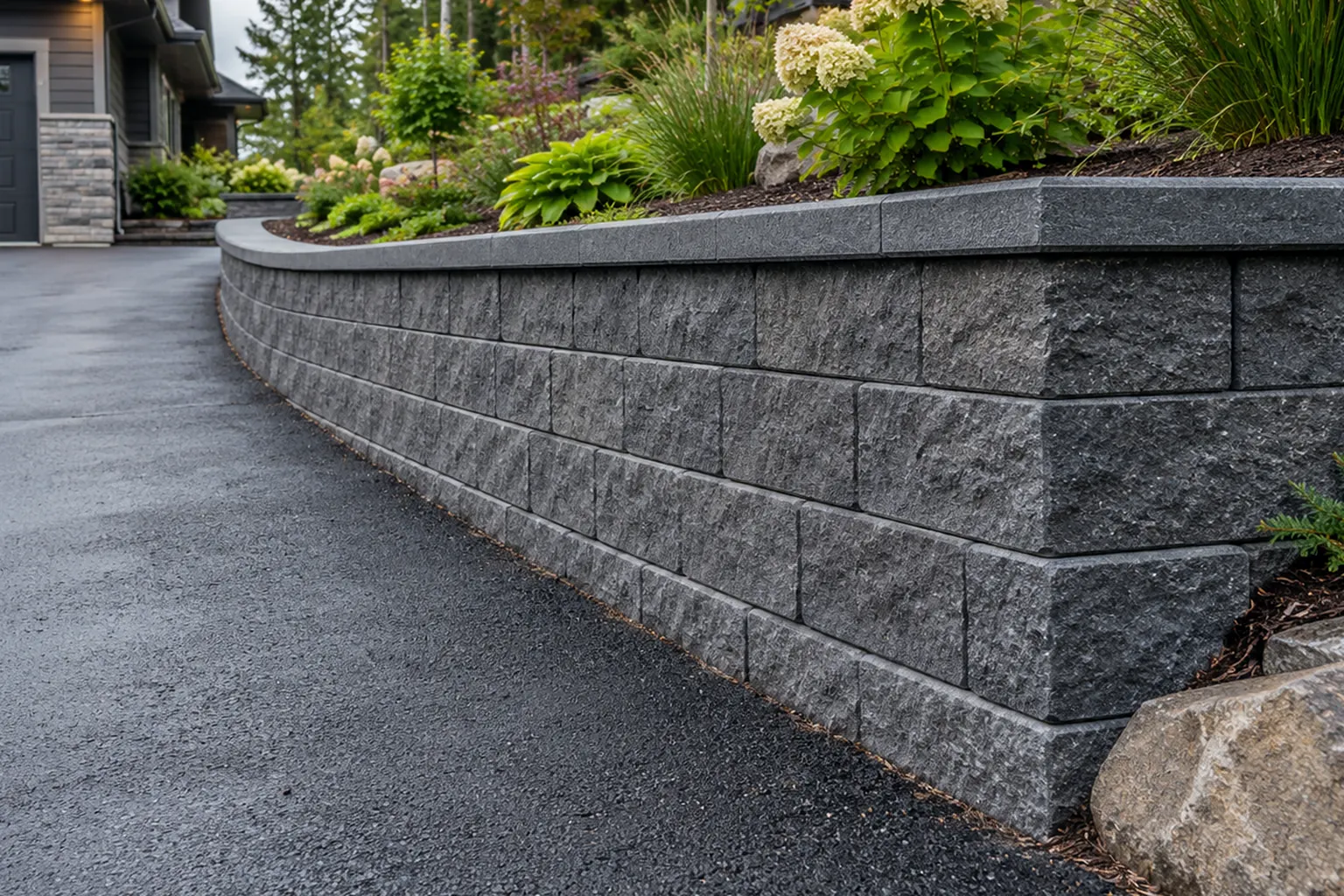
Driveway Retaining Walls
Walls that widen, level or hold up a driveway, designed for vehicle weight, snow storage and plow traffic.
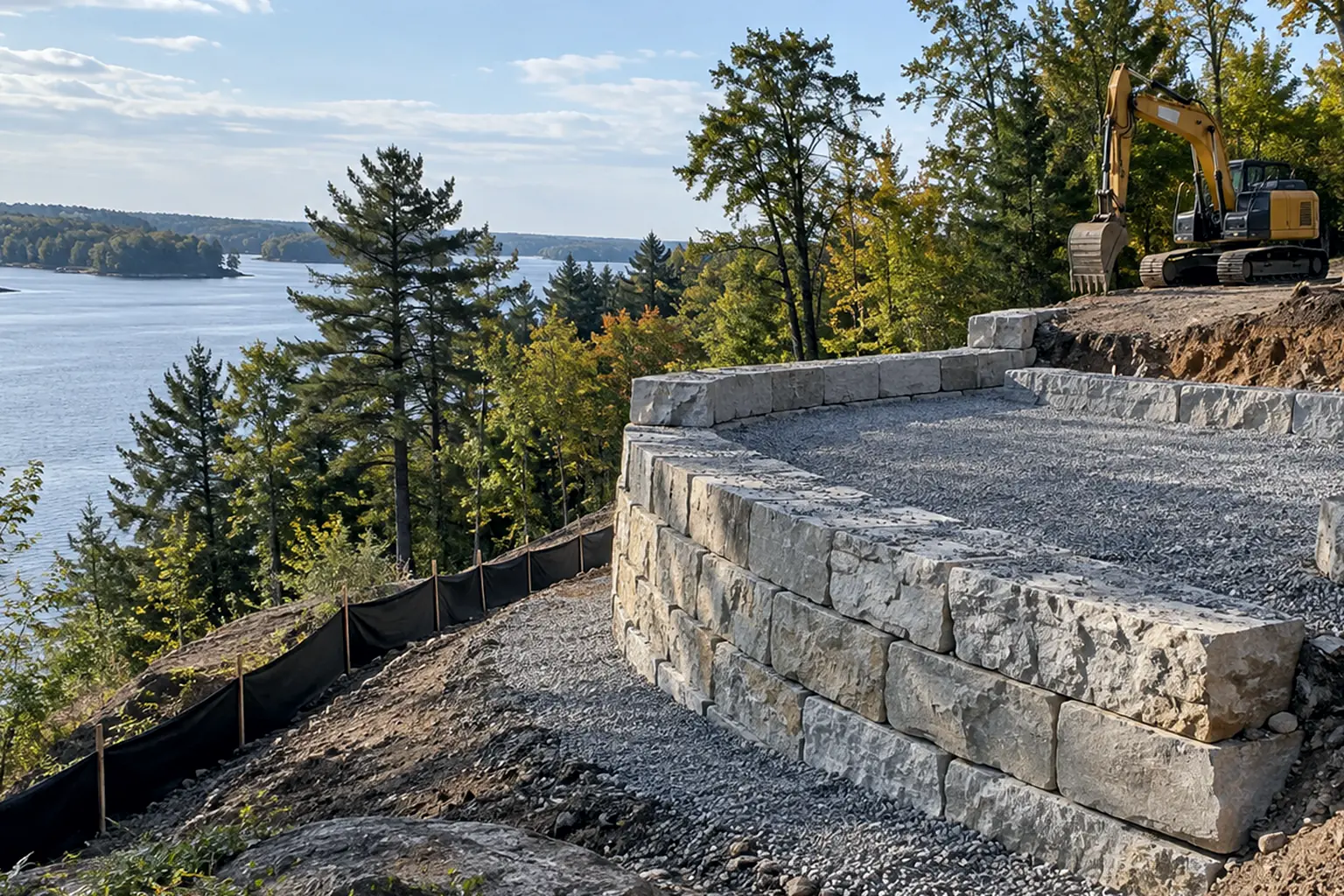
Riverbank and Shoreline Retaining Walls
Stone walls and bank stabilization for properties on the Saint John River, the Nashwaak and local streams.
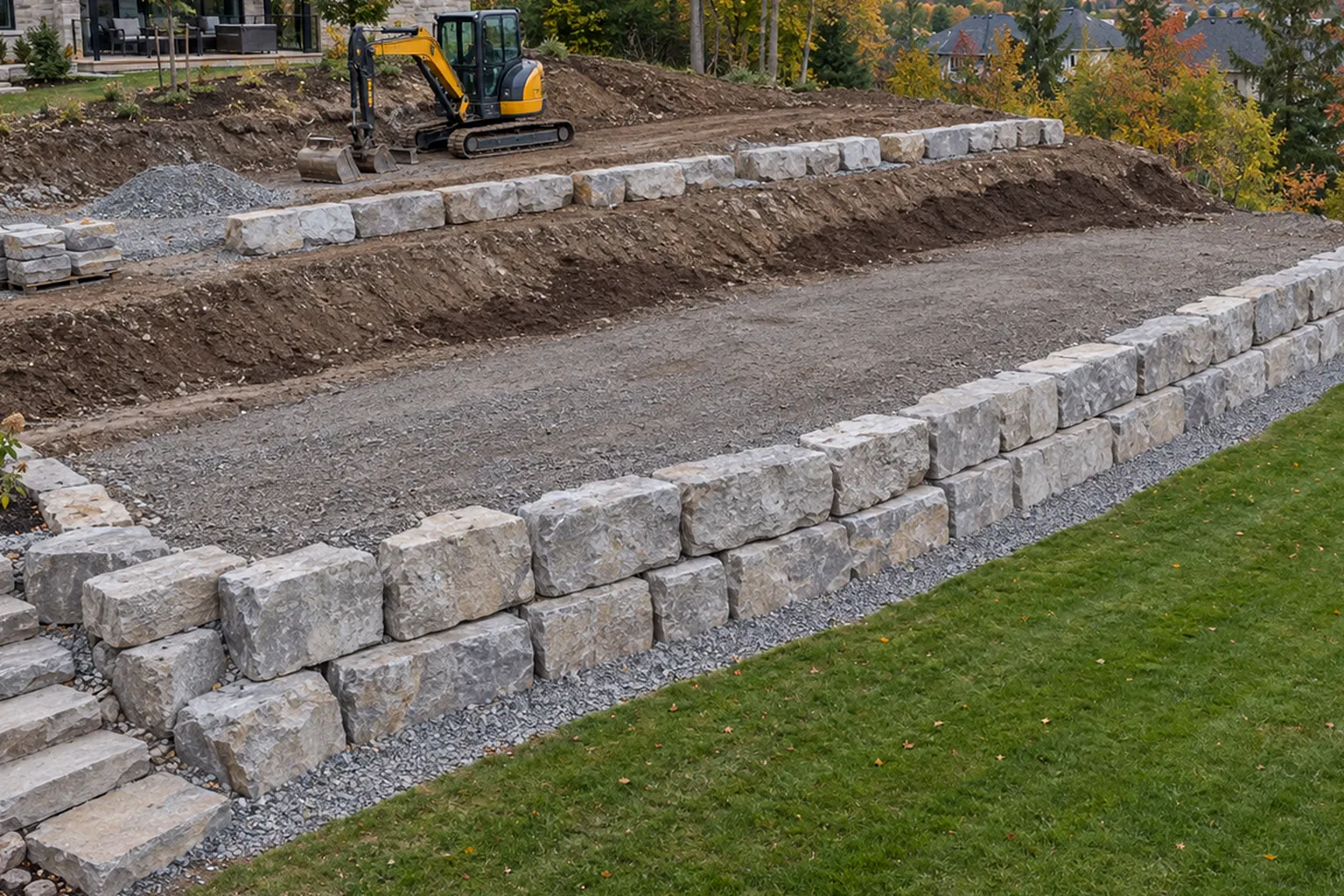
Terraced Retaining Walls
Two or more stepped walls that break a steep slope into level, usable tiers with planting and steps between them.
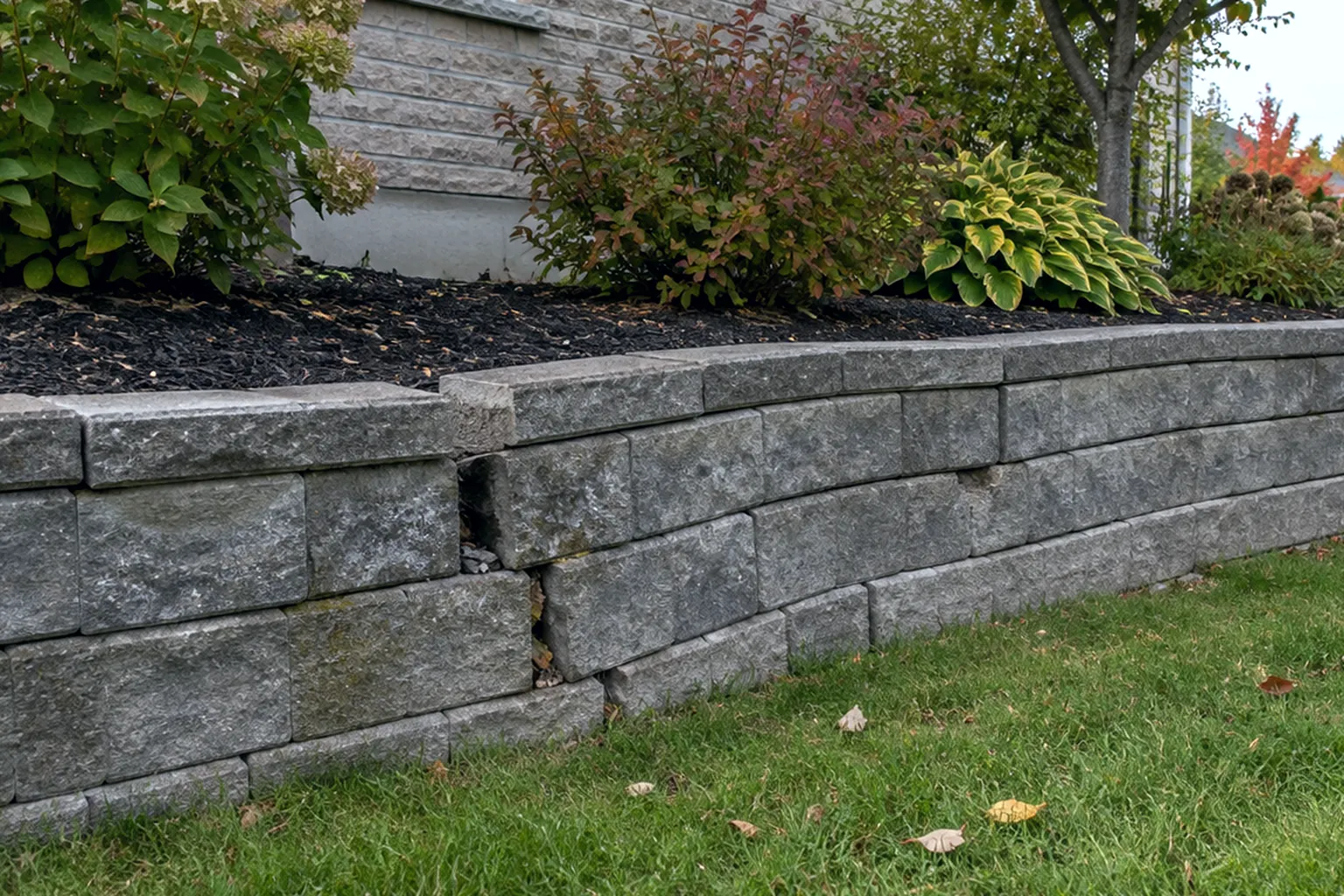
Retaining Wall Repair and Replacement
Repair of loose, bulging or failed sections and full replacement of rotting timber and leaning walls.
What does a retaining wall do on a Fredericton property?
A retaining wall holds soil at two different levels so you can use ground that would otherwise be a slope. On Fredericton lots that usually means a flat backyard where there was a bank, a driveway cut into a hill, a level patio beside the house, or a stable edge along the river where the bank keeps creeping toward the lawn.
The wall itself is only the visible part. Behind it sits a zone of clean drainage stone, a perforated drain at the base, and in taller walls, layers of geogrid that tie the wall into the hillside. Those hidden parts decide whether the wall stays straight for decades or starts to lean after a few winters.
Why do retaining walls fail in the Saint John River valley?
Retaining walls in the Saint John River valley fail mainly because water gets trapped behind them and freezes. Much of the low ground around Fredericton is fine silt and clay laid down by the river, and those soils hold water, drain slowly and swell when they freeze. A wall backfilled with that same soil carries the weight of wet earth plus the push of frost every winter.
The usual result is a wall that bulges in the middle, tips forward at the top or settles at one end. Once a wall starts moving, each freeze–thaw cycle pushes it a little further. Building it right the first time means excavating the clay out of the zone behind the wall, replacing it with free-draining stone, and giving the water a clear way out at the bottom.
What every job includes
Drainage planned before digging
Every wall gets a drainage path from the stone behind it to a safe outlet.
Bases built for frost
Compacted crushed stone on firm ground, with the first course buried below grade.
Itemized written estimates
Each part of the job is listed so you can compare options line by line.
Fully insured crews
Insured for the excavation and construction work on your property.
How does Fredericton's winter affect a retaining wall?
Fredericton's long, cold winters drive frost deep into the ground, and the repeated freeze–thaw swings of late fall and early spring are harder on a wall than steady cold. Each time saturated soil freezes it expands, pressing on the back of the wall; each thaw lets it settle again, and the wall rarely returns exactly to where it started.
To control that movement we set walls on a compacted granular base rather than on native soil, bury the first course below grade, keep the backfill zone free-draining, and grade the top of the wall so snowmelt runs away from it instead of soaking in behind. On walls that support a driveway, we also plan for the extra load of snowbanks and plow traffic.
Which retaining wall material suits your site?
The right retaining wall material depends on the height of the wall, how much room you have behind it, the look you want, and what sits above it. Armour stone suits natural, heavy walls on larger lots; concrete block suits tidy, curved or stepped walls in subdivisions; poured concrete suits tight spaces and structural loads; and natural stone or veneer suits feature walls near the house.
We explain the trade-offs on site. Compare armour stone, concrete block, poured concrete and natural stone walls, or read about walls for driveways, riverbanks and terraced slopes.
How a project moves from first call to finished work
Call or send the form
Tell us the address, what the wall needs to hold and roughly how long and tall it is. Photos of the slope help.
Site visit and measurements
We check the soil, drainage, access for equipment and anything above or below the wall.
Free written estimate
An itemized estimate with the wall type, drainage, base depth and any removal or permits.
Build and clean-up
Excavation, base, drainage and wall, then backfill, grading and a tidy site.
How much does a retaining wall cost in Fredericton?
The cost of a retaining wall in Fredericton depends mostly on its length and height, the material, how much soil has to come out, and how easily equipment can reach the site. Height matters more than people expect: a wall twice as tall holds back far more soil and usually needs deeper excavation, more drainage stone, geogrid reinforcement and sometimes an engineered design.
Other things that move the price are removing an old wall, poor clay that has to be hauled away, steps or curves, lighting or caps, and whether the work is near the river. Your free estimate is written and itemized, so you can see how each of those parts adds up and compare options such as a lower terraced pair of walls against one taller wall.
Do you need a permit for a retaining wall in Fredericton?
Whether a retaining wall in Fredericton needs a permit depends on its height, its location on the lot and what it supports, so we check with the City of Fredericton before building anything substantial. Taller walls, walls near a property line and walls that hold up a driveway or structure are the ones most likely to need approval and an engineer's design.
Waterfront lots add a second layer of approval. Because the province regulates construction close to rivers, streams and wetlands, a wall near the Saint John River or the Nashwaak is planned around that review from the first site visit, and the schedule allows for it, so the wall goes in once and stays in.
What makes a retaining wall last for decades?
A retaining wall lasts for decades when its base, drainage and reinforcement are matched to the soil and height it has to hold. The base is a trench excavated to firm ground, filled with crushed stone and compacted in lifts. The drainage is clean stone behind the wall with a perforated pipe that daylights to a safe outlet. Reinforcement, where needed, is geogrid laid back into the slope at set intervals.
The finish details matter too. Caps are glued so frost cannot lift them, the top of the backfill is sealed with less permeable soil so surface water runs off, and fabric keeps silt from clogging the stone. These steps add a little time during the build and prevent the expensive rebuilds we are called to on older walls.
When should you replace a retaining wall instead of repairing it?
Replace a retaining wall when the whole wall is leaning, the timbers are rotting, or the drainage behind it never worked; repair it when the damage is limited to a few loose stones, a failed cap or one short section. Many walls around Fredericton built from railway ties or landscape timbers in past decades are now reaching the end of their life.
Waiting tends to raise the cost, because a failing wall lets soil slide into the yard, undermines fences and patios above it, and can push into a driveway. Our repair and replacement page explains the warning signs and what a proper rebuild involves.
What should a retaining wall estimate include?
A retaining wall estimate should include the wall type and block or stone, the length and height, the depth and material of the base, the drainage stone and pipe, any geogrid, removal of old walls or soil, and the finish details such as caps and steps. If any of those lines is missing, two quotes that look similar may describe very different walls.
Ask how the drainage will exit, how deep the first course sits below grade, and whether permits or engineering are included. A low price that leaves out drainage is the most common reason we end up rebuilding a wall that is only a few years old.
Can a retaining wall fix a wet or soggy yard?
A retaining wall can help fix a wet or soggy yard when the water is coming off a slope above, because the drainage built behind the wall intercepts groundwater and carries it to a planned outlet. Many Fredericton backyards stay soggy into June because clay soil holds spring meltwater at the bottom of a bank.
Levelling the yard with a wall, adding a perforated drain at its base, and grading the new surface to shed water can turn that wet strip into usable lawn. Where water comes from a neighbouring lot or a roof, we include swales or downspout connections so the wall is not asked to handle more than it should.
When is the best time to build a retaining wall in Fredericton?
The best time to build a retaining wall in Fredericton is from late spring, once the ground has thawed and the spring freshet has passed, through late fall before the ground freezes. Dry summer and early fall weather makes excavation cleaner and compaction more reliable, especially in clay.
Because the building season is short, the calendar fills early. Booking your site visit in winter or early spring gives time for design, any permits and material orders, so your wall can be one of the first built when the ground is ready.
Why the work pays off
- Turns an unusable slope into flat lawn, patio or garden space
- Stops soil from washing onto driveways, walkways and patios
- Protects foundations and fences at the top of a bank
- Holds riverfront and creek banks against spring runoff
- Adds structure and curb appeal that suits the house
Retaining wall questions from Fredericton property owners
How much does a retaining wall cost in Fredericton?
It depends on the wall's height and length, the material, excavation, drainage and access. We visit the site and give you a free, itemized written estimate so you can compare materials and layouts.
Are you insured?
Yes. Fredericton Retaining Wall Builders is fully insured for the excavation and wall construction we do.
How tall can a retaining wall be without an engineer?
It depends on the wall type, the soil and what sits above it. Taller walls and walls carrying driveways or buildings usually need an engineered design, and we confirm the requirements with the City of Fredericton before building.
Can you build next to the river?
Yes. Riverfront walls need provincial approval before any digging, so we start that paperwork early and build once it is in place.
Do you remove the old wall?
Yes. Removal and disposal of timber, block or stone walls can be included in the estimate, along with any poor soil behind them.
How long does a retaining wall take to build?
A short garden wall can take a day or two; long or tall walls with drainage, geogrid and steps take longer. Your estimate includes a realistic schedule.
Which communities around Fredericton do you serve?
We build retaining walls across Fredericton, on both the north side in Nashwaaksis, Marysville and Douglas and the south side from the uptown hills to Lincoln. We also work in Oromocto, New Maryland, Hanwell, Kingsclear, Keswick Ridge and Nasonworth. If your property is farther along the Saint John River, call and ask; larger projects often make the trip worthwhile.
Call 1 (506) 305-7444Service area
Fredericton, New Brunswick
- Oromocto
- New Maryland
- Hanwell
- Lincoln
- Nashwaaksis
- Marysville
- Douglas
- Keswick Ridge
Plan your retaining wall with a free estimate
Call 1 (506) 305-7444 or send the form with your address and a few photos. Every estimate is free, written and itemized.